

Utah Market Data
The Fed Cut Rates. Mortgage Rates Went Up. Why?
The Fed's annual Jackson Hole conference runs this week, and new Fed Chair Warsh gives his first keynote Friday. So this week we step back from Utah data to answer a question I hear all the time. The Fed has been cutting rates, so why are mortgage rates still going up?
Where Rates Stand
The Fed's short-term rate sits at an effective 3.63%, inside a target range of 3.50% to 3.75%. It has come down 1.7 percentage points since 2024.
Mortgage rates have gone the other way. The 30-year fixed averaged 6.65% this past week, per Freddie Mac. A year ago it was 6.58%. The 10-year Treasury is at 4.66%, up 0.39 points on the year. The 30-year Treasury sits near 5.16%, its highest since 2007.
What Sets Mortgage Rates
The fed funds rate (what banks charge each other to borrow overnight) is the one rate the Fed controls. It drives credit cards, HELOCs, and floating-rate bridge loans. Mortgages and most fixed-rate CRE loans price off the 10-year Treasury plus a spread (the extra a lender charges above that benchmark). Investors set the 10-year by buying and selling bonds. The Fed does not set the 10-year.
What 26 Years of Data Shows
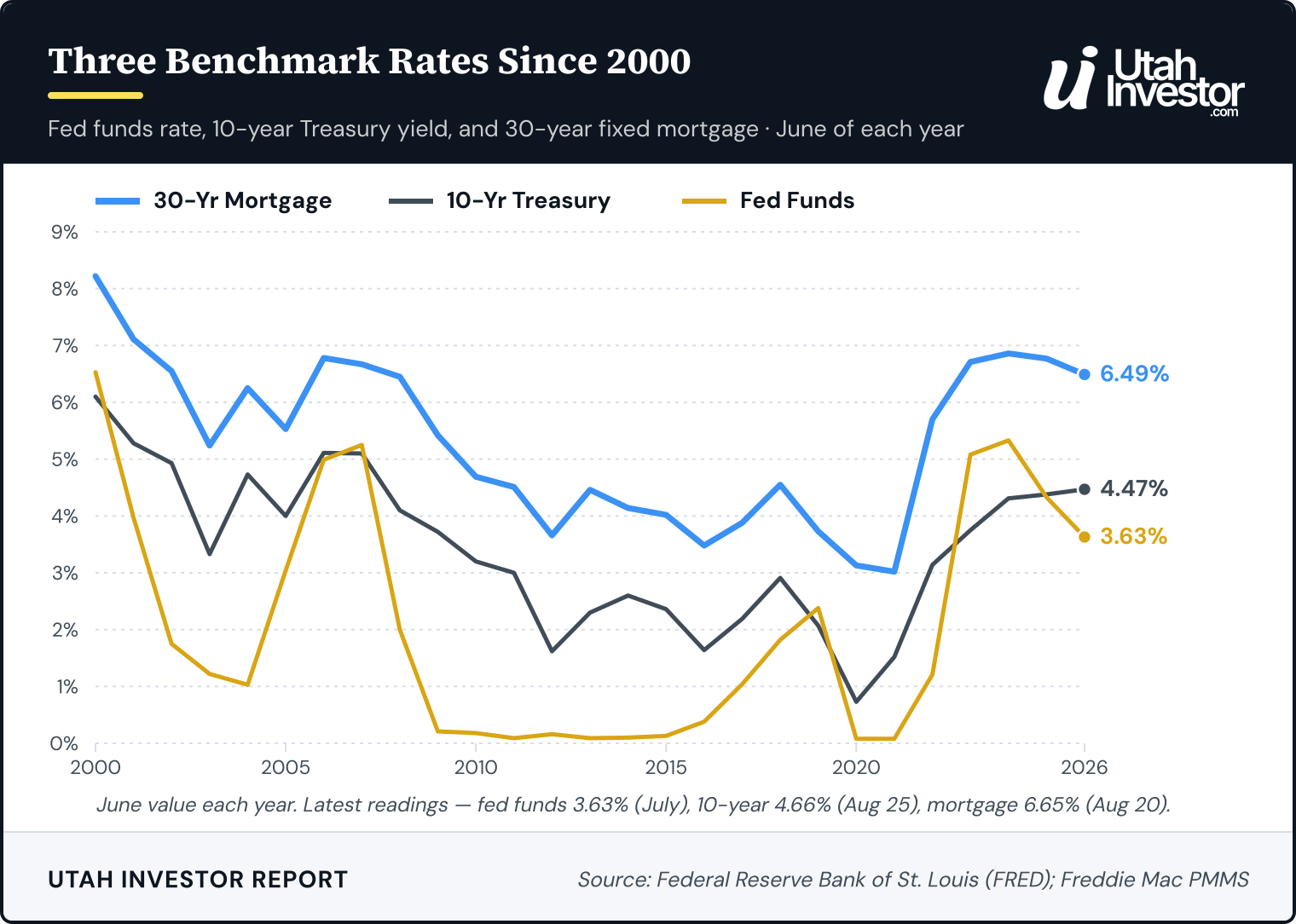
The solid lines run on the June reading of each year so the years compare evenly. The dashed step on the right is where each rate sits today.
The two rates have moved apart before. From 2004 to 2007 the Fed raised its rate 4.2 points, from 1.03% to 5.25%, while the 30-year mortgage moved less than half a point, from 6.25% to 6.67%. From 2009 through 2015 the Fed held below 0.25% for seven straight years and mortgages never got under 3.66%. Since 2024 it has run the other way, with the Fed cutting 1.7 points while the mortgage rate ended up higher than a year ago.
The Gap Between Mortgages and the 10-Year
That gap was 1.64 points in June 2018 and widened to 2.96 in June 2023. This June it was 2.02. The narrowing is the only rate relief borrowers have gotten this cycle, and it came from the bond market settling down rather than from Fed cuts.
Why Long Rates Stay High
The federal government carries roughly $40 trillion in debt and keeps borrowing. The Treasury said last week it would at least double its bond buyback program to hold yields down, and the dip lasted about a day. Warsh has also stopped telling markets where rates are headed next, so bond investors want extra yield to cover the uncertainty.
The Bottom Line
If you are waiting on Fed cuts to refinance or make a deal pencil, the last two years say don’t hold your breath. Mortgage and CRE rates follow the 10-year, and that rate is up 0.39 points over the past year while the Fed cut 1.7. With so much debt and uncertainty in the market, don’t expect rates to retreat any time soon.
Data sourced from the Federal Reserve Bank of St. Louis (FRED), Freddie Mac Primary Mortgage Market Survey, and CNBC Treasury market coverage, August 25, 2026.
Mid-Year Tax Prep Property Review

Featured Listings


» Custom Investor List: commercial listings with price reductions in last 7 days

Sold Multi-Units This Week
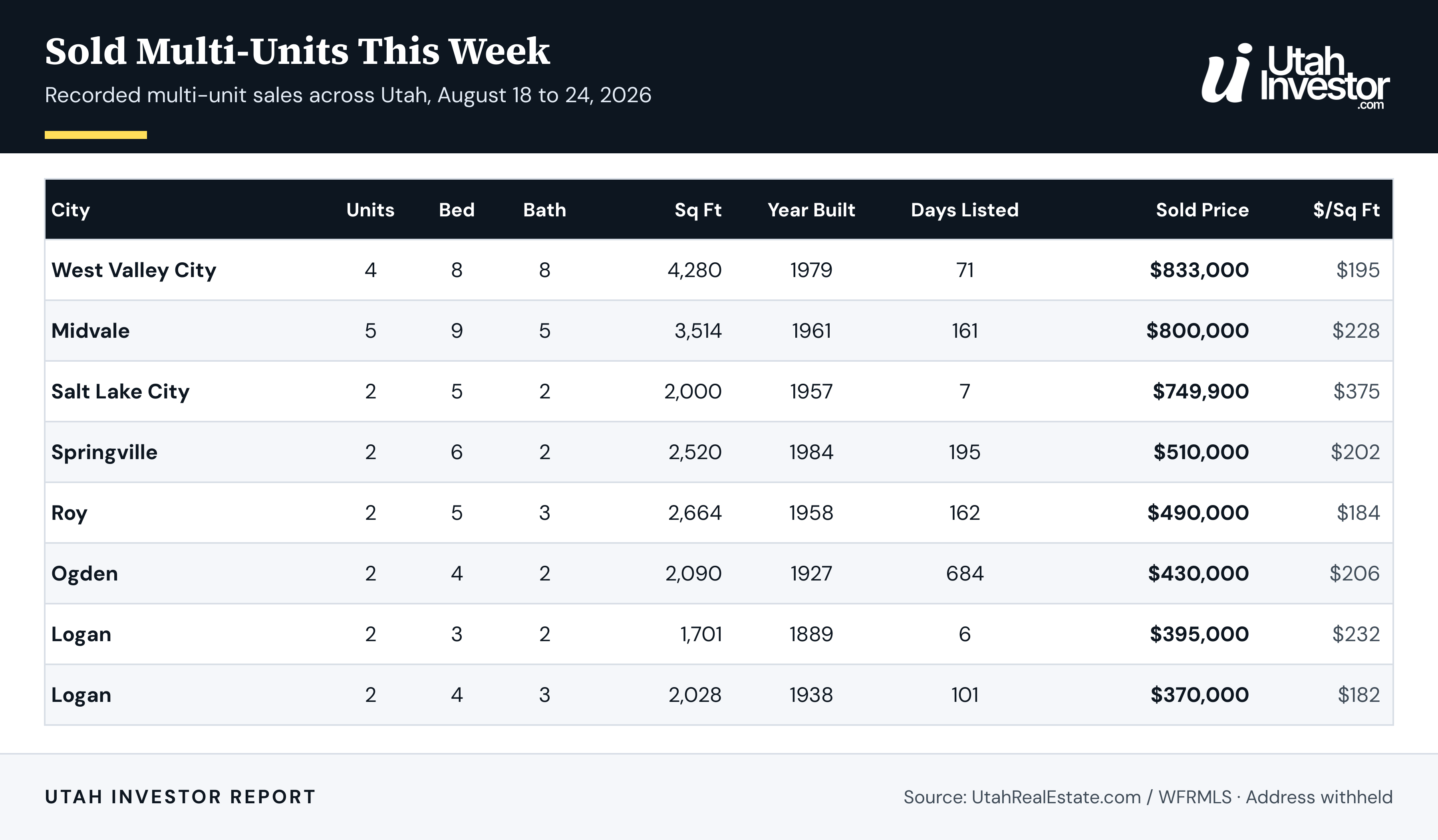
8 recorded multi-unit sales statewide, August 18 to 24, 2026. Six were duplexes, plus a fourplex in West Valley City and a five-unit in Midvale. Prices ran from $370,000 for a 1938 Logan duplex to $833,000 for the West Valley City fourplex. Six of the eight closed below asking. Days on market ran from 6 to 684.
Click chart to view larger image
Request a Free Property Valuation
Mortgage Rates & Financing
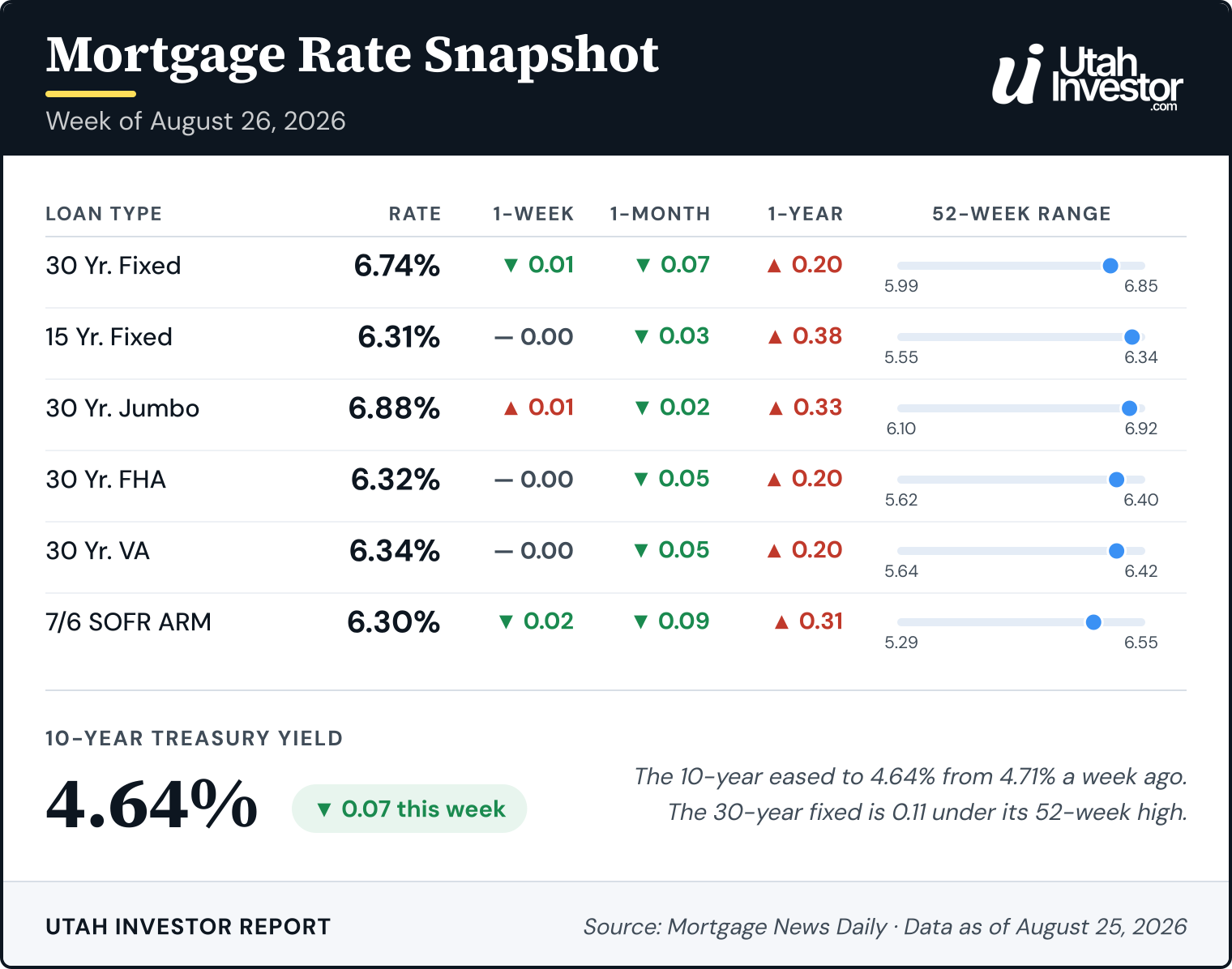
Mortgage rates were quiet this week. The 30-year fixed sits at 6.74%, down 0.01 from a week ago and down 0.07 over the past month. Compared to one year ago, rates are 0.20 higher. The 7/6 SOFR ARM (an adjustable loan fixed for the first seven years) is at 6.30%, offering a 0.44 discount to the 30-year fixed.
The 10-year Treasury yield eased to 4.64% from 4.71% a week ago as oil prices fell. Since mortgage rates track the 10-year, that small dip is what kept rate sheets flat this week. The next test comes Friday, when Fed Chair Warsh gives his first Jackson Hole speech, and any reaction in the bond market will show up in mortgage rates quickly.
Source: Mortgage News Daily, rates as of August 25, 2026
Click chart to view larger image
Headlines & Insights
Utah Headlines
Cox Admits Utah's Housing Push Has Not Moved Prices — Just over 7,400 of the governor's promised 35,000 starter homes have reached the market since 2023, and Salt Lake County's median single-family price hit a record $645,000 anyway.
You Now Need $186,827 a Year to Buy the Median Salt Lake County Home — The income required to afford a $645,000 median-priced home rose 7.75% in one quarter, up from $173,392, the highest bar in two years.
Six in Ten Utah Buyers Are Now Shopping Outside Their Own Market — Cross-market house hunting has climbed to 60% of buyers across the 100 largest metros, up from 48% in 2019, while the average Salt Lake County sale price reached $694,113 in July, a 6.1% yearly gain.
Salt Lake City Puts $7 Million Into Affordable Housing and Ownership — The city's Community Reinvestment Agency is splitting the money between $3 million in development loans and $4 million for shared-equity ownership programs.
National Headlines
New Home Sales Fall 10.5% as Builders Cut Prices to Move Inventory — July sales ran at an annual rate of 607,000 with 9.6 months of supply on the market, and the median new home is now $40,300 cheaper than the median existing home, the widest gap since 1999.
One in Seven Home Purchase Contracts Fell Apart in July — Redfin counted 14% of deals canceled nationally, the most since November 2023, with 51% more sellers than buyers in the market; Salt Lake County had 928 homes under contract on July 31, down 11% from 1,048 a year earlier.
Mountain West Multifamily Values Fell 10.3% While the Rest of the Country Rose — Trepp data shows appraisal cap rates in the Mountain division widened 107 basis points since 2022, the largest jump of any region, pushing prices to about $170,900 per unit against a national median of $138,500 that climbed 8.6%.
Apartment Vacancy Drops to 4.5% as Demand Soaks Up New Supply — Stronger household formation absorbed the construction wave, and high mortgage costs kept more households renting instead of buying.
CRE Borrowing Costs Stopped Falling in the Second Quarter — All-in commercial rates dropped just 4 basis points from the first quarter, against a 45-point drop in late 2025, with apartments still the cheapest category to finance at 5.22%.
Request a Free Property Valuation

David Robinson - Principal Broker | Investor

Disclaimer: Canovo Group LLC is not a registered broker-dealer, investment adviser, or financial advisor. This email is for informational purposes only and does not constitute an offer to sell, solicitation of an offer to buy, or a recommendation of any securities or investment strategies. All investments carry risk, including the potential loss of principal. Recipients should perform their own due diligence and consult with their own legal, tax, and financial advisors before making any investment decisions. Canovo Group LLC it’s licensed brokers or agents do not endorse, guarantee, or verify the accuracy of any third-party information provided herein.